AI Customer Service: How Intelligent Agents Are Revolutionizing the Customer Experience — Complete Guide
How AI agents transform e-commerce customer service: concrete benefits, business KPIs, implementation roadmap. From chatbots to omnichannel AI agents.

AI Customer Service: How Intelligent Agents Are Revolutionizing the Customer Experience
"70% of consumers abandon their cart if customer support takes more than 5 minutes to respond." Instacart Report
For an e-commerce or support director, this is no longer just a customer experience issue: it is a daily revenue loss.
In a context of increasing pressure on margins and heightened demand for responsiveness, AI agents are radically transforming the way brands manage their customer interactions. Juggling seasonal peaks, recurring questions, and complex requests? It is time to evolve your tools.
In this article, you will discover how customer service automation enables your teams to focus on what truly matters: loyalty, personalization, and conversion. Concrete examples, clear business indicators, and an accessible roadmap: everything you need to transition to AI without losing the human touch.
Table of Contents
- The evolution of AI in customer service
- Concrete benefits of AI agents for your business and customers
- The future of customer service: toward an optimal AI-human balance
- How to effectively implement this technology in your organization
The Evolution of AI in Customer Service
From chatbots to AI agents: a quiet revolution
AI agents represent much more than enhanced chatbots. Specifically designed for customer service, they deliver instant, personalized responses 24/7, propose concrete solutions to your agents, and resolve many issues without human intervention.
This technological leap radically transforms the customer experience by guaranteeing permanent availability and personalized interactions. For an e-commerce site, this concretely means the ability to handle demand peaks during sales or Black Friday without additional hiring.
Why AI appeals to large enterprises
AI adoption in customer service is progressing rapidly, particularly in midmarket and large enterprises. The figures are telling: 32% of companies with over 250 employees already use AI, compared to 18% for those employing between 50 and 99 people.
This trend is driven by tangible results: 86% of companies using AI report measurable improvement in customer satisfaction. Even more impressive, AI agents manage to automate up to 80% of routine interactions (in specific cases), improving response times by a factor of 4.
McKinsey confirms this trend, with 83% of executives identifying chatbots as the most relevant AI application for optimizing their customer service (we are far from the era when chatbot was synonymous with disappointment). ROI can reach impressive levels, up to 28 times the initial investment in some cases, according to McKinsey.

Types of AI agents explained
To choose the right solution for your e-commerce business, understanding the different types of AI agents is essential:
- Text chatbots
- Features: Text message comprehension, contextualized responses, offer personalization
- E-commerce use cases: Frequent order questions, product technical support, knowledge management
- Voicebots
- Features: Voice recognition and synthesis, natural language processing
- E-commerce use cases: Delivery status information, phone orders
- Omnichannel AI agents
- Features: Autonomous customer issue management across all channels (email, chat, apps)
- E-commerce use cases: Consistent experience between your website, mobile app, and social media
- Assist agents
- Features: Real-time response suggestions for human agents, summary of previous interactions to simplify team processing
- E-commerce use cases: Advisor support during sales peaks, faster support ticket backlog reduction
- AI agents for emails/tickets
- Features: Automated responses to common emails, ticket categorization
- E-commerce use cases: Order confirmation, product return request management
Concrete Benefits of AI Agents for Your Business and Customers
24/7 availability and instant responsiveness
The demand for immediacy is particularly strong in e-commerce. A customer waiting for a response at 10 PM to finalize their order potentially represents a lost sale. AI agents offer that service continuity that your human teams cannot provide without prohibitive costs.
This permanent availability directly improves your conversion rates. Studies show that a simple one-second delay in response time can lead to a 7% drop in conversions. In e-commerce, where every interaction counts, this responsiveness becomes a decisive competitive advantage.
A concrete case: an e-commerce site during sales season
Take the example of a fashion platform that sees its support requests multiply by five during summer sales. Without an AI agent, two options typically present themselves:
- Hire temporarily (costly and complex)
- Accept a degradation in service quality (risky)
With an AI agent, this same platform can simultaneously handle hundreds of requests about sizes, availability, and delivery times, without increased costs. Concrete result: 42% reduction in tickets escalated to human agents during seasonal peaks (midmarket average observed with the Botmind AI agent).
Operational cost reduction and resource optimization
Initial investment vs ROI
Let us put the numbers on the table: in-house AI solution development typically represents an investment of 55,000 to 137,000 euros all-inclusive in the first year if the company (retail SMB) develops it themselves. An amount that may seem substantial, especially with ongoing development costs and post-first-year modifications.
However, there are solutions like Botmind offered as SaaS, meaning by subscription, so you only pay for an automation service as long as you need it, and benefit from expert guidance.
Key indicators you will quickly see with a SaaS solution (analysis based on the period from January 1, 2024 to November 30, 2024, across 22 clients):
- Average response time divided by 4
- Operational costs reduced by up to 31%
- Team productivity improved by 24%
- Customer satisfaction increased by 29%
New distribution of human roles
Beyond direct savings, AI fundamentally transforms the role of your support teams. Gone are the days when your best staff spent their days answering the same questions about delivery times or return policies.
While AI agents handle these standardized requests, your advisors can focus on higher-value missions: premium client loyalty, complex case management, or process improvement. According to Gartner, 80% of companies will use AI agents by 2026, completely redefining support roles.
A customer relations manager (Ambre M.) testifies:
"Without Botmind, I would have to work from 8am to 11pm!"
Client personalization and sales growth
Personalization is no longer a luxury but a necessity in e-commerce. According to a McKinsey study, 76% of consumers say they are frustrated when an experience is not personalized, and 78% say that relevant personalization encourages them to recommend or repurchase from a brand (source McKinsey). Artificial intelligence now enables this level of personalization at scale, transforming customer relations and offering e-merchants the ability to deliver an experience worthy of a personal advisor, but for thousands of customers simultaneously.
By analyzing purchase history, preferences, and browsing behavior, AI agents recommend relevant products and anticipate specific needs. This contextual personalization translates directly into increased average basket size and enhanced loyalty: according to the Boston Consulting Group, personalization can generate a 6 to 10% revenue increase for retail businesses, two to three times faster than other growth levers. Furthermore, a Segment study indicates that 44% of consumers are likely to become repeat buyers after a positive personalized experience.
In a context where customer acquisition is becoming increasingly expensive, the ability to personalize every interaction establishes itself as a strategic competitive advantage and a powerful growth lever.
The Future of Customer Service: Toward an Optimal AI-Human Balance
Ethical and regulatory challenges of AI
Before addressing future developments, it is important to mention the regulatory framework governing AI use in customer relations. GDPR and upcoming European regulations impose strict requirements in terms of transparency and data processing.
Your responsibility as a decision-maker is to ensure:
- Full transparency about AI use in your customer interactions
- Complete traceability of algorithmic decisions
- Active prevention of bias in automated responses
- Strict compliance with user data rights
CNIL notably recommends clearly informing your customers when they interact with an AI agent, and allowing them easy access to a human advisor when needed.
Emerging trends in AI customer service
AI agents are rapidly evolving toward increasingly sophisticated capabilities. The features that will shape the market in the coming years include:
- Precise emotional detection, enabling response tone adaptation to customer sentiment
- Continuous learning that improves responses through interactions
- The ability to proactively detect recurring problems and suggest preventive solutions
By 2030, more than 700 million AI agent users in customer service are projected worldwide (Source BCG). E-commerce platforms that have not integrated these technologies will be clearly disadvantaged against competition on a lasting basis.
Why the hybrid AI-human approach matters
Despite AI's rapid progress, the hybrid approach remains the optimal model. In this system, AI agents efficiently handle standardized requests, while your team members focus on issues requiring empathy and judgment.
This complementarity meets consumer expectations: 54% still prefer interacting with a human advisor to resolve complex or emotionally charged issues. AI is not here to replace your teams, but to make them more effective and fulfilled in their roles.
A gaming retailer successfully adopted this approach:
"The goal is to maximize customer autonomy so support agents can focus on sales, after-sales support, and high-value requests. Setting up and creating Botmind workflows is relatively straightforward."
Preparing the transition to augmented customer service
Where to start?
To effectively integrate AI into your customer service strategy, begin by identifying repetitive, low-value tasks in your customer service: answering frequently asked questions, order tracking, standard return management.
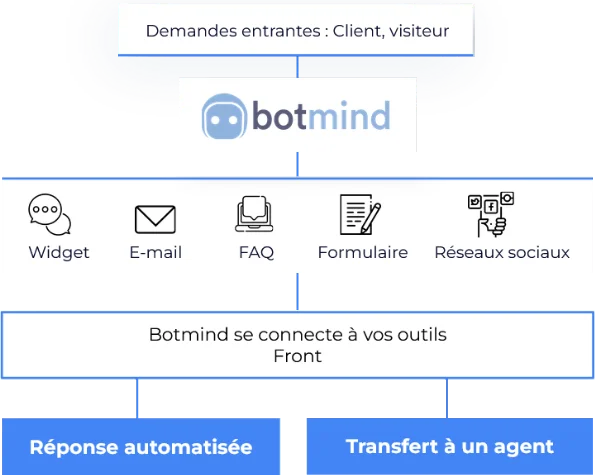
Solutions like Botmind enable you to progressively automate these tasks without a radical overhaul of your processes. The email support automation module is particularly suited to e-commerce organizations looking to optimize their email ticket processing.
Implementation methodology for e-commerce platforms
A successful transition requires a methodical approach:
- Analyze your current workflows and identify friction points
- What is your average response time?
- What are the 10 most frequently asked questions?
- Which processes consume the most human resources?
- Implement AI progressively, starting with a single channel
- Often start with chat on your site (if you have one), which is simpler to automate
- Then extend to emails, and eventually to calls
- Train your teams to collaborate with AI agents
- Agents must understand how AI assists them
- Create clear escalation processes for complex cases
- Measure results with precise KPIs
- First contact resolution rate
- Cost per interaction
- NPS and customer satisfaction before/after implementation
Key Takeaways for E-commerce Decision-Makers
You made it to the end? Great. Here is the essential takeaway:
AI is not here to replace your teams. It frees them up.
Customers expect answers in under 10 minutes, not tomorrow.
Your support costs can decrease while customer satisfaction rises.
The ROI of a well-implemented AI solution is often visible in under a year.
And that customer who was hesitating at 10 PM? Thanks to AI, they got their answer... and made the purchase.
First action? Automate responses to your incoming emails with a tool like Botmind.
The future of customer support will be neither cold nor distant. It will be fast, intelligent... and human-driven.
Further reading
- Agentic Commerce Protocol — The emerging standard defining how AI agents execute commerce transactions autonomously: permissions, audit trails, and human confirmation triggers.
- Universal Commerce Protocol — A standardised interface layer allowing AI agents to query product catalogues, verify availability, and initiate transactions across any e-commerce platform.
Automate your e-commerce customer service with AI
Request a demo